

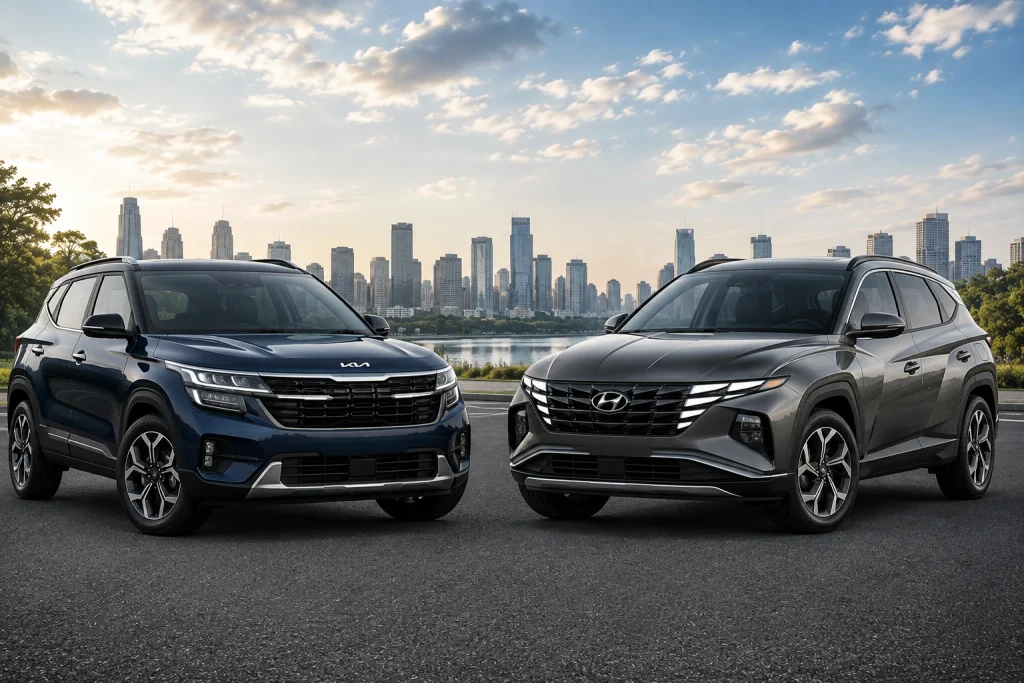
Here’s something most comparison articles won’t tell you upfront: the Kia Seltos and Hyundai Tucson aren’t actually the same size. Shoppers cross-shop them all the time because the prices overlap, but the Tucson is a full compact SUV while the Seltos is a smaller, subcompact one, nearly a foot shorter end to end.
That size gap is the whole story here. The Kia Seltos is the nimble, efficient, budget-friendly pick, while the Tucson is bigger, more powerful, and pricier. So the real question for Mentor buyers isn’t which is “better,” it’s which size and price fit your life.
Quick Answer: Choose the Kia Seltos if you want a lower price (mid-$20,000s), better fuel economy, easier parking, and available all-wheel drive for less money. Choose the Hyundai Tucson if you want more cargo space, more passenger room, and stronger power, and don’t mind paying several thousand more to get it. For value-focused Mentor buyers, the Seltos usually wins; for families needing max space, the Tucson makes the case.
They’re Not Actually the Same Size
This is the difference that drives everything else. The Tucson measures about 182.7 inches long, while the Seltos comes in around 172.6, roughly ten inches shorter. That’s not a rounding error, it’s a genuine class gap.
Those ten inches show up everywhere. The Tucson offers noticeably more rear legroom and a much bigger cargo hold, about 38.7 cubic feet behind the back seats versus the Seltos’s 26.6. For a growing Mentor family loading strollers, hockey bags, and a Costco run all at once, the Tucson simply holds more.
The flip side is that the Seltos is easier to live with in tight spots. Squeezing into a snug spot in downtown Willoughby or a packed lot at Great Lakes Mall is simpler in the smaller Kia, and its shorter body makes it feel more nimble around town. If you rarely fill a cargo area to the roof, the Seltos’s size is a feature, not a compromise.
Which One Costs Less to Buy and Own
The Seltos wins this round clearly, and it’s not close. It starts in the mid-$20,000s, while the 2026 Tucson starts around $32,550, a gap of roughly $5,000 to $8,000 depending on trim.
That price difference is the Seltos’s strongest argument. For many Mentor buyers, five to eight thousand dollars is the deciding factor, full stop. It buys a lot of gas, winter tires, or simply a lower monthly payment.
The Seltos also sips a bit less fuel, landing around 31 mpg combined against the Tucson’s 26, thanks to its lighter body and smaller footprint. Over a year of commuting from Mentor to Cleveland, that efficiency edge quietly adds up. Both come backed by strong warranties, but Kia’s 10-year/100,000-mile powertrain coverage is a genuine peace-of-mind bonus that’s worth factoring in. If you want to dig deeper into how the two brands stack up, our Kia vs Hyundai breakdown covers it in more detail.
Where the Tucson Earns Its Higher Price
The Tucson isn’t just bigger, it’s genuinely more capable, and honesty demands giving it real credit. Its base engine makes 187 horsepower against the Seltos’s 147, so it feels stronger merging onto I-90 or passing on a two-lane road.
It also brings more standard tech and a more upscale cabin feel at the higher trims, along with that considerable space advantage. And importantly for Ohio, the Tucson offers a hybrid and even a plug-in hybrid version, something the Seltos doesn’t offer at all. For a high-mileage Mentor commuter chasing maximum efficiency, the Tucson Hybrid is worth a serious look that the gas-only Seltos can’t answer.
So the Tucson’s higher price isn’t just for a badge. You’re paying for more space, more power, and more powertrain options. Whether that’s worth several thousand dollars comes down to how much you actually need those things.
What About Ohio Winters
Both handle snow well with all-wheel drive, but there’s a cost angle worth knowing. Mentor sits in the Lake Erie snowbelt, and up toward Chardon the area regularly sees over 100 inches of snow a year, so AWD is a smart call here.
The good news for value shoppers: the Seltos offers available all-wheel drive at a much lower entry price than the Tucson. You can get genuine snowbelt traction without stretching to the Tucson’s sticker. Either way, pair your choice with a set of dedicated winter tires, because in a serious lake-effect squall on Route 2, good rubber matters even more than which SUV you picked.
If you find the Seltos a touch small but love the value, it’s also worth looking at the Kia Sportage, which sits right between the Seltos and Tucson in size and goes head-to-head with the Hyundai directly.
Frequently Asked Questions
Is the Kia Seltos smaller than the Hyundai Tucson?
Yes, noticeably. The Seltos is about 10 inches shorter overall, making it a subcompact SUV versus the Tucson’s compact class. The Tucson has more cargo room and rear legroom as a result.
Which is cheaper, the Seltos or the Tucson?
The Seltos, by a wide margin. It starts in the mid-$20,000s, while the 2026 Tucson starts around $32,550, a difference of roughly $5,000 to $8,000 depending on trim.
Which gets better gas mileage?
The Seltos, slightly, at around 31 mpg combined versus the Tucson’s 26. Note the Tucson also offers hybrid and plug-in hybrid versions for buyers who want maximum efficiency.
Does the Kia Seltos come with all-wheel drive?
Yes. AWD is available across most Seltos trims and standard on the SX, giving Mentor drivers snowbelt traction at a lower price than the Tucson.
Which should I buy for a Mentor family?
If you need maximum space and power, the Tucson. If you want value, efficiency, and easier parking and don’t regularly max out cargo, the Seltos is the smarter buy for most Mentor drivers.
Compare Both at Ken Ganley Kia Mentor
The best way to feel that size-and-value difference is to sit in the Seltos yourself and decide whether you need the Tucson’s extra room, or whether the smaller Kia’s lower price and easy footprint fit your life better.
Visit Ken Ganley Kia Mentor at 9090 Mentor Ave. to explore the Seltos lineup and check current new vehicle specials.
Connect with us


- August 2026
- July 2026
- June 2026
- May 2026
- April 2026
- December 2025
- November 2025
- October 2025
- September 2025
- August 2025
- July 2025
- June 2025
- May 2025
- April 2025
- March 2025
- February 2025
- January 2025
- December 2024
- November 2024
- October 2024
- September 2024
- August 2024
- July 2024
- June 2024
- May 2024
- December 2023
- November 2023
- October 2023
- September 2023
- August 2023
- July 2023
- June 2023
- May 2023
- April 2023
- March 2023
- February 2023
- January 2023
- December 2022
- November 2022
- October 2022
- September 2022
- August 2022
- July 2022
- June 2022
- May 2022
- April 2022
- March 2022
Archives
- 2024 Kia EV6
- 3-Row Seating
- Auto Financing
- Car Financing
- Car Leasing in Mentor
- Day Trips
- Electric Vehicles
- EV Market
- Family Friendly Vehicles
- Family Fun in Mentor
- Holidays In Mentor
- Ken Ganley Kia Mentor
- Ken Ganley Kia Mentor Service
- Kia Brake Repair
- Kia Carnival
- Kia EV6
- Kia EV9
- kia forte
- Kia K5
- Kia Niro
- Kia Seltos
- Kia Sorento
- Kia Soul
- Kia Sportage
- Kia Telluride
- Kirtland Hills Kia Dealer
- Kirtland Hills Kia Service
- Kirtland Hills Used Cars
- Mentor Amenities
- Mentor Foodies
- Mentor Kia Dealer
- Mentor Living
- Mentor Restaurants
- Mentor Used Cars
- Midsize Sedan
- Ohio Traveling
- Spacious Vehicles
- Things to Do in Mentor
- Tires in Mentor OH
- Uncategorized
- Versatile Vehicles
Categories
 Warranties include 10-year/100,000-mile powertrain and 5-year/60,000-mile basic. All warranties and roadside assistance are limited. See retailer for warranty details.